
1Department of Physiotherapy, Santosh Paramedical College and Hospital, Ghaziabad, India
2Professor/Principal, Department of Physiotherapy, Santosh Paramedical College and Hospital, Ghaziabad, India
3Assistant Professor, Department of Physiotherapy, Santosh Paramedical College and Hospital, Ghaziabad, India
4Dean, Santosh Paramedical College and Hospital, Ghaziabad, India
5Tutor, Department of Physiology, Santosh Medical College, Santosh Deemed to Be University Ghaziabad, India
Corresponding Author Email: deepak.raghav@santosh.ac.in
Article Publishing History
Received: 02/07/2026
Accepted After Revision: 01/08/2026
This research aims to design, develop, and validate a newly self-reported questionnaire specifically focused on assessing the QWL of allied health professionals. By utilizing a multi-phase development process that incorporates expert input, pilot testing, and psychometric analysis, this study will contribute to a deeper understanding of the factors that influence AHPs’ work-life quality. The findings will not only inform the design of workplace interventions to improve AHPs’ well-being but also provide a robust tool for future research in this domain. The purpose of thisstudy isto develop and validate a self-reported questionnaire specifically designed to assess the Quality of Work Life (QWL) among allied health professionals.Across-sectionalstudy was conducted to assess the quality of work life among allied health professionals (N=101) employed in various healthcare settings. Data were collected at a single point in time using a structured, self-developed questionnaire. The sample included a diverse range of allied health professionals such as speech therapists, physiotherapists, psychologists, nurse assistants, occupational therapists, and others.
These allied health professionals were selected based on their active involvement in patient care across various clinical and community health environments. The questionnaire consisted of 40 items covering eight key domains: professional development, available facilities, work environment, quality of work,safety, health, job satisfaction, and opportunitiesfor growth and development. The study successfully validates a newly developed Quality of Work Life (QWL) questionnaire for Allied Health Professionals, demonstrating a strong positive correlation (r = 0.835) with existing standardised tools. This confirms the construct validity and reliability of the new scale, making it suitable for practical application in assessing work-life quality. The new QWL tool is a valid and effective instrument for measuring quality of work life. The self-reported questionnaire is a valid, reliable, and context-specific instrument for assessing QWL among AHPS. This can be used in healthcare organisations for workforce assessment.
Allied Health Professionals, Self-Reported Questionnaire, Quality of Work Life.
Aakansha, R. Deepak, Apoorva, R. K. Sharma, Deepika. Development and Psychometric Validation of a Newly Designed Self-Reported Questionnaire Assessing Quality of Work Life Balance among Allied Health Professionals. SSN Journal of Management & Technology Research Journal. 2026;3(2).
Aakansha, R. Deepak, Apoorva, R. K. Sharma, Deepika. Development and Psychometric Validation of a Newly Designed Self-Reported Questionnaire Assessing Quality of Work Life Balance among Allied Health Professionals. SSN Journal of Management & Technology Research Journal. 2026;3(2). Available from: <a href=”https://shorturl.at/dLx36“>https://shorturl.at/dLx36</a>
INTRODUCTION
The term “Quality of Work Life” refers to the overall satisfaction and emotional well-being of employees, encompassing factors such as work environment, job satisfaction, work-life balance, opportunities for professional development, and the presence of supportive management and organizational culture [1]. Quality of life (QoL) is an important measure of overall well-being linked to physical, mental, social, and environmental aspects of health [2].
Legislation enacted in early 20th century to protect employees from risks inherent in job and to eliminate hazardous working conditions, followed by the unionization movement in the 1930s and 1940s were the initial steps [3]. WHO defined AHPs as “participants who have specific connections with the art and science of healthcare and are recognized as members of the health team in the national health System. They are educated at professional levels in a recognized, accredited health or health related institute [4]. Quality of life at work is an important and widely discussed concept in the literature. Several instruments can be used to measure it, but with regard to healthcare5.
A review of available instruments intending to capture the quality of life of healthcare and social services workers (QoLHSSW) is necessary to better assess their working conditions and promote programs/guidelines to improve these conditions [5]. Allied health professionals, which include physiotherapists, occupational therapists, speech-language pathologists, radiographers, and many others, make up a large portion of the healthcare workforce. Their roles are indispensable in the diagnosis, treatment, and rehabilitation of patients [6]. However, despite their crucial contribution to patient care, their work environment and the quality of their professional life remain underexplored in comparison to other healthcare professionals such as doctors and nurses [7].
The focus of this paper is to explore the various dimensions that affect the quality of work life for allied health professionals. Furthermore, the increasing attention towards the measurement of life satisfaction among healthcare workers highlights the necessity for healthcare organisations to enhance the quality of work life (QWL) to cultivate a skilled and dedicated staff, which plays a crucial role in improving patient outcomes [8].
Research has shown that poor quality of work life among healthcare professionals can lead to burnout, reduced job satisfaction, increased turnover, and poorer patient outcomes [9]. Given the crucial role that allied health professionals play in healthcare systems, it is essential to create an environment that supports their well-being, promotes job satisfaction, and fosters long-term career sustainability [10]. However, despite the importance of AHPs, there is a notable lack of research that specifically examines the factors contributing to their quality of work life.
This research aims to design and develop a self-reported questionnaire that assesses the quality of work life for allied health professionals. The questionnaire will focus on several key domains that includes work-related stress, job satisfaction, workload management, emotional well-being, organizational support, professional development opportunities, interpersonal relationships with colleagues, and work-life balance. By creating a reliable and valid instrument, this research seeks to provide an effective tool for assessing the QWL of AHPs in diverse healthcare settings, ranging from hospitals to private clinics
MATERIAL AND METHODS
The questionnaire was filled out by allied health professionals working in clinics, hospitals, and other medical setups. There were all age group allied healthcare professionals having the experience of 6 months or more in a healthcare job. Conducted a comprehensive review of existing QWL to understand current frameworks and identify gaps. This study was done by collecting data from a population of (N=101) allied health professionals working in different setups at a single point in time. The questionnaire was collected after being conducted by the AHP’s under the mentioned criteria. In this study, the assessment of a large sample of allied health professionals working in the healthcare department was done. The sample was formed by allied health professionals (speech therapists, physiotherapists, psychologists, nurse assistants, Occupational Therapists.
Study design and technique: This study was done as cross-sectional and aimed at developing and validating a self-reported questionnaire to assess the Quality of Work Life (QWL) among Allied Health Professionals (AHPs) with a population (N=101). Ethical clearance was obtained from the institutional ethical committee (REF NO.- SCOP/OCT-24/ECN-94510023668) before the commencement of the study.
The research was done in three phases: questionnaire development, data collection, and validation. At first, a 40-item questionnaire was designed based on literature review and expert input, covering eight key domains such as professional development, work environment, and job satisfaction. The Data was collected from 101 AHPs working in hospitals, clinics, and rehabilitation centres. Participants had a minimum of six months’ work experience.
In this research, the self-made questionnaire was made to assess the quality of work life in our sample. The questionnaire involves 40 questions designed to assess eight domains of aspects of this construct: professional development, facilities provided, work environment, quality of work, safety, and health and lastly growth and development. Normative data was conducted by allied health professionals. In this study, Allied Health Professionals aged 21 years and above were selected that defined the working population in healthcare.
A survey study using new developed and designed questionnaire that was conducted among randomly selected 101 employees working in hospitals, clinics, rehab centres with age of more than 20years and had more than 6 months of experience of working. Questionnaire had the total of 40 items under 5 headings that was made for the study of quality of work life in allied health professionals. The self-reported questionnaire to assess the Quality of Work Life (QWL) among Allied Health Professionals (AHPs) was developed using well-known theories from occupational health and organizational behaviour. Questions were created to reflect the real experiences of AHPs and reviewed by experts to ensure they were clear and relevant.
The inclusion criteria were followed as Professional Status as Allied Health Professionals (AHPs) Participants those were registered or licensed allied health professionals working in the field of allied health, Work Setting Healthcare, worked in any healthcare setting, including but not limited to: Hospitals (public or private), including inpatient and outpatient departments. Rehabilitation Centres, including physical therapy and occupational therapy clinics. Professional Experience and Employment Status; – Minimum Work Experience: Participants who had a minimum of 6 months to 1 year of professional experience in their respective allied health roles were taken. The age criteria were of 20 years and above of the working allied health professionals.
The exclusion was the Non-Allied Health Professionals, Individuals who did not belong to an allied health profession, such as doctors, or administrative staff, were excluded, less than 6 months of professional experience were excluded, Unemployed AHPs, Individuals who were retired, on extended leave, For Statistical analysis, statistical techniques were used to combine the results of self-reported questionnaire, this involved finding validity of the self-reported questionnaire. Participants were provided with the study’s purpose, benefits, risks, and confidentiality agreements. Informed consent was obtained from the participants. Participants filled out the questionnaire.
RESULTS
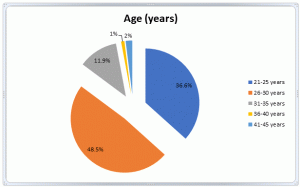
Table 1: Frequency and Percentage of Age of Allied Health Professionals to assess the Quality of Work Life
| Age | Frequency | Percent |
| 21-25 years | 37 | 36.6 |
| 26-30 years | 49 | 48.5 |
| 31-35 years | 12 | 11.9 |
| 36-40 years | 1 | 1.0 |
| 41-45 years | 2 | 2.0 |
| Mean ± SD | 27.33 ± 4.179 years | |
Above table shows mean age of 27.33 years and majority 48.5% professionals were belonged to 26-30 years, 36.6% professionals belonged to 21-25 years, 11.9% professionals belonged to 31-35 years and rest of belonged to more than 36 years age group.
Figure 1
RESULT
TABLE 2: CONSTRUCT VALIDITY OF QWF SCALE
| Scale | Correlation test value |
| Current QWL questionnaire Vs already existence of questionnaire related quality of work life | 0.835 |
Above table shows that correlation value was showing strong positive correlation (value tend to 1) between Current QWL questionnaire total score Vs already existence of questionnaire related quality of work life total score. Here existence Questionnaire has low score than new Questionnaire score because of taking different ordinal score.
A positive correlation value shows that when new questionnaire score increases than existence questionnaire scores also increase. According to result, questionnaires are showing same effect on patients. The results indicate that the questionnaires exhibit similar effects on participants. The newly developed questionnaire may replace the existing instrument as it provides improved results and comprehensively covers all aspects related to quality of work life.
This newly developed quality of work life questionnaire is now suitable for use among Allied Health Professionals.”
Figure 2

TABLE 3: CONSTRUCT VALIDITY OF QWF SCALE
| Scale | Correlation test value |
| Current QWL questionnaire Vs already existence of questionnaire related quality of work life | 0.835 |
Above table shows that correlation value was showing strong positive correlation (value tend to 1) between Current QWL questionnaire total score Vs already existence of questionnaire related quality of work life total score. Here existence Questionnaire has low score than new Questionnaire score because of taking different ordinal score. Positive correlation value shows that when new questionnaire score increases than existence questionnaire scores also increase. According to result, questionnaires are showing same effect on patients. We can use our questionnaire in place of existence questionnaire because new scale gives better result than old one and cover all aspect regarding quality of work life than others.
Figure 3
DISCUSSION
The study developed and validated a novel self-reported questionnaire specifically designed to assess the quality of work life (QWL) among allied health professionals (AHPs). Drawing on established instrument‑ development frameworks and psychometric guidelines, approach mirrored prior rigorously validated QWL in healthcare domains. The present study aimed to design, develop, and validate a self-reported questionnaire that assesses the Quality of Work Life (QWL) of allied health professionals (AHPs). Given the increasing recognition of work-life quality as a critical factor in workforce retention, job satisfaction, and service delivery efficiency, a reliable and context-specific instrument tailored for AHPs was deemed necessary [11].
In this study on the Quality of Work Life (QWL) among allied health professionals offers several strengths that make it methodologically and analytically stronger than the previous Nagpur study on Quality of work life of nurses working at tertiary health care institution: a cross-sectional study by Thakret al. (2017), particularly in terms of instrument validation, participant focus, and depth of analysis [12].
This study on allied health professionals demonstrates high construct validity with a correlation coefficient of 0.835, indicating a strong positive relationship between the newly developed QWL questionnaire and an already established QWL measure. This statistical evidence confirms that your tool is accurately capturing the intended constructs. In contrast, the Nagpur study does not report any validation or reliability testing of their questionnaire, raising concerns about the internal consistency and measurement accuracy of their tool. In the Nagpur study, while 70.4% reported satisfaction with the work environment, over 60% expressed dissatisfaction with issues like gender discrimination, indicating deeper systemic concerns.
In contrast, this research revealed moderate satisfaction levels, with many participants choosing neutral responses in key domains such as growth opportunities and organizational support. This reflects a workforce that is not necessarily dissatisfied, but may be underserved or lacking proactive institutional support. The Nagpur study focused exclusively on nurses, whereas the present study broadens the scope to a wider spectrum of Allied Health Professionals, including physiotherapists, occupational therapists, speech therapists, psychologists, and nurse assistants.
This diversification allows for a more comprehensive understanding of QWL across disciplines that are often underrepresented in QWL research. In this study, it showed more balanced satisfaction levels across domains without such strong negative indicators, suggesting a relatively healthier workplace experience overall. A strong positive correlation was found between the total score of the new QWL questionnaire and an already existing standardized QWL instrument. This high correlation confirms the construct validity of the new tool, indicating that it effectively measures the same underlying concepts related to work life quality. The positive association also suggests that the new scale, despite possible differences in scoring methodology, aligns closely with established instruments.
Given its broader coverage and improved structure, the new questionnaire can be confidently recommended for use in future assessments and organizational planning. This study not only validates a reliable tool to measure quality of work life but also uncovers critical insights into the lived work experiences of Allied Health Professionals. While many professionals report moderate satisfaction, the high levels of neutrality across several domains suggest untapped potential for improvement. Addressing these areas can lead to enhanced motivation, retention, and productivity in the healthcare workforce.
CONCLUSION
The newly developed QWL questionnaire for allied health professionals is a valid and reliable tool that fills a critical gap in workforce research and management. The study successfully developed and validated a context-specific, self-reported questionnaire to measure the Quality of Work Life among allied health professionals. The tool demonstrated strong content validity, construct validity, and reliability, suggesting its potential usefulness in both research and practical workforce management.
Ethical Clearance: Ethical clearance was obtained from Santosh College of Physiotherapy, Santosh Medical College and Hospital, Ghaziabad, dated 18-10-24 (REF NO.- SCOP/OCT-24/ECN-94510023666).
Conflict of Interest– None
Funding- Self-funded
ACKNOWLEDGEMENTS
The authors acknowledge all those who provided support and constructive input throughout this research.
Data availability: The data associated with the paper are not publicly available but can be obtained from the corresponding author upon reasonable request
REFERENCES
- Leitão J, Pereira D, Gonçalves Â. Quality of Work Life and Organizational Performance: Workers’ Feelings of Contributing, or Not, to the Organization’s Productivity. Int J Environ Res Public Health. 2019;16(20):3803. doi:10.3390/ijerph16203803
- Younis J, Wang L, Abed A, et al. Quality of life among healthcare workers in the hospitals and primary healthcare centers in Gaza Strip: a cross-sectional study. BMC Psychol. 2025;13(1):69. doi:10.1186/s40359-025-02386-9
- Rosner D, Markowitz G. A Short History of Occupational Safety and Health in the United States. Am J Public Health. 2020;110(5):622-628. doi:10.2105/AJPH.2020.305581
- Hales P, Achour N, King O, Engward H. Elevating the allied health professions workforce: leadership’s role in shaping professional identity. BMC Health Serv Res. 2026;26:327. doi:10.1186/s12913-026-14064-6
- Wang L, Touré M, Poder TG. Measuring quality of life at work for healthcare and social services workers: A systematic review of available instruments. Health Care Sci. 2023;2(3):173-193. doi:10.1002/hcs2.53
- Gaur V. An Overview of redefining paradigm: India’s Allied Health Professional. Int J Biochem Biomed Res. 2018;1(1):20-34.
- Singh A, Chakradhar R, Joshi N. Job Satisfaction among Nurses Working in a Tertiary Level Government Hospital. Medical Journal of Shree Birendra Hospital. 2021;20(1):30-35. doi:10.3126/mjsbh.v20i1.28777
- Rashid I, Amin F. Mediating role of quality of work life between work-related social capital and life satisfaction among health professionals. Arab Gulf Journal of Scientific Research. 2023;42(4):1700-1715. doi:10.1108/AGJSR-07-2023-0350
- De Hert S. Burnout in Healthcare Workers: Prevalence, Impact and Preventative Strategies. Local Reg Anesth. 2020;13:171-183. doi:10.2147/LRA.S240564
- Mertala SM, Kanste O, Keskitalo-Leskinen S, Juntunen J, Kaakinen P. Job Satisfaction among Occupational Therapy Practitioners: A Systematic Review of Quantitative Studies. Occup Ther Health Care. 2022;36(1):1-28. doi:10.1080/07380577.2021.1964146
- Vu TQ, Nguyen BT, Pham VNH, et al. Quality of Work Life in Healthcare: A Comparison of Medical Representatives and Hospital Pharmacists. Hosp Top. 2021;99(4):161-170. doi:10.1080/00185868.2021.1875278
- Thakre SB, Thakre SS, Thakre SN. Quality of work life of nurses working at a tertiary health care institution: a cross-sectional study. Int J Community Med Public Health. 2017;4(5):1627. doi:10.18203/2394-6040.ijcmph20171775.